Advancing Clinical Testing, Research and Education
When SARS-CoV-2 emerged in Arizona, we took swift action to protect our community. Partnering with the state, we established multiple public testing sites to ensure widespread access to reliable COVID-19 diagnostics.
As a CLIA-certified (CLIA #03D2180875) and CAP-accredited laboratory (CAP #8948877), our team upholds the highest standards of accuracy, safety and regulatory compliance.

We were the first in Arizona to introduce saliva-based COVID-19 testing, offering a less invasive, highly accurate, high throughput and resource-efficient alternative to traditional methods. Our innovative approach reduces the need for medical personnel while maintaining exceptional diagnostic precision. The clinical testing procedures that currently hold CAP accreditation include:
SARS-CoV-2 molecular testing
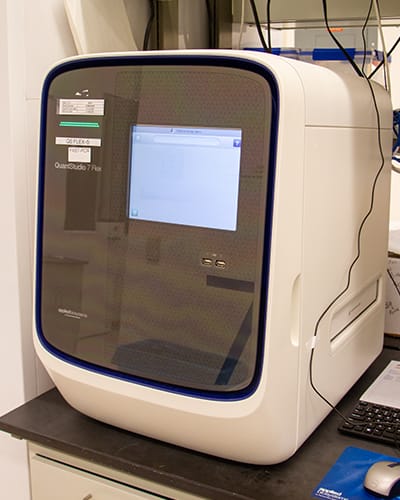
QuantStudio™ 7 Flex Real-Time PCR System
Designed for running a wide range of qPCR applications with high accuracy and sensitivity featuring extensive multiplexing capabilities through 6 decoupled filter channels and seamless automation integration.
Due to decreased demand, ASU’s COVID-19 testing option ended operations in June 2024. Testing for the ASU community ceased Dec. 6, 2024.
In all, ASU began in early 2021 and ultimately processed more than 1.5 million tests. Test results will remain available at abctl.asu.edu.
For COVID testing needs, please contact your primary care physician or refer to U.S. Food & Drug Administration FAQs on over-the-counter tests.
SARS-CoV-2 immunoassay testing
ASU Biodesign Clinical Testing Laboratory offers serological diagnostic tests to detect Immunoglobulin G and total antibodies to SARS-CoV-2 in human serum and plasma using DS2/EVOLIS systems.
Located at the Biodesign Institute at Arizona State University, our facility is equipped with an array of state-of-the-art equipment covering a wide range of testing needs.
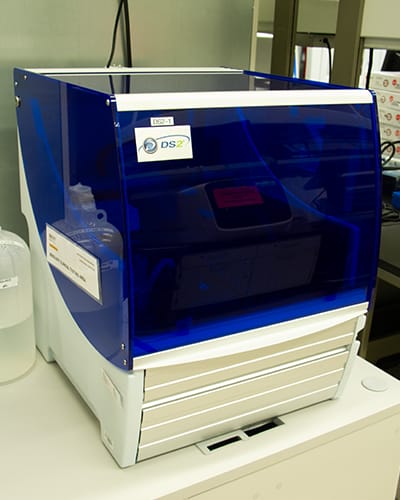
DYNEX DS2® 2-Plate System
Automated testing with multi-assay management of up to 100 samples on-board and 2-plate incubator.
With a highly secure HIPAA-compliant Laboratory Information System including a patient portal, case tracking system and advanced laboratory infrastructure, we provide:
• Reliable test results direct to participants
• Researchers, educators and healthcare partners with the tools needed for high-impact studies and training.
Contact [email protected]
Types of COVID-19 tests
Did you know that you can be infected with the coronavirus and spread it to others even if you don’t have symptoms?
Knowing which test to get can be confusing. What kinds of COVID-19 tests are available? What is the difference between a PCR test and an antigen test? Antigen vs. antibody? What is the most accurate COVID-19 test? This chart can help you understand and choose.
| Test | PCR (RT-PCR, qPCR or molecular) test | Antigen (rapid) test | LAMP (rapid home) test | Antibody (serology) test |
|---|---|---|---|---|
| Summary | The most accurate diagnostic test. It can tell you if you are infected with the coronavirus. ASU’s saliva tests are PCR tests. | The fastest diagnostic test, but not highly accurate. Most useful for screening groups of people in settings where rapid or repeated testing is needed. | This rapid at-home diagnostic test is similar to PCR but may be less accurate. | Tells you if you had COVID-19 in the past. Not a diagnostic test. Do not use it to detect a current infection. |
| What is it? | A PCR test detects genetic material from the coronavirus using a nasal swab, nasopharyngeal swab or saliva sample. | An antigen test detects proteins from the coronavirus (called antigens) using a nasal or throat swab. | The loop mediated amplification reaction (LAMP) test detects genetic material from the coronavirus using a nasal swab. Patients can run the test from start to finish at home. | This blood test detects antibodies to the coronavirus. Antibodies are proteins your body produces to help fight off future infections. |
| What does it tell you? | A positive result means you are infected with the coronavirus. A negative result means the virus was not detected.* | A positive result means you are infected with the coronavirus. A negative result means the virus was not detected.* | A positive result means you are infected with the coronavirus. A negative result means the virus was not detected.* | A positive result means you had the coronavirus in the past. Your body takes about 1-3 weeks after infection to develop antibodies. A negative result means no antibodies were detected.A positive antibody test does not guarantee that you are immune to the virus. We do not know how much protection antibodies provide or how long they remain in the body. |
| How accurate is it? | This is the most reliable test available for COVID-19. However, it takes several days to build up enough virus in the body be measured. People who are tested early (up to 5 days after exposure) may test negative even if they are infected — a false negative. This is due to the incubation time of the virus, which takes a while to appear in body fluids. If you do not have symptoms, you should wait 5 days after you were potentially exposed to the virus before getting tested. PCR tests are not likely to produce false positives. If you get a positive test result, you can be confident that you are infected. | This test is not as accurate as a PCR test. It is more likely to produce false negatives, especially after the first week of infection. This means you could be infected with the coronavirus even if you receive a negative test result. Also, like with PCR tests, people who are tested within 5 days after exposure may not have enough virus in their bodies to detect.Recent studies suggest that this test is only useful for individuals with symptoms. It does not detect the virus in asymptomatic or pre-symptomatic patients. If you have COVID-19 symptoms, you should follow self-isolation recommendations even if you get a negative antigen test result. | This test is not as accurate as a PCR test. The false-positive rate appears to be higher, so you could get a positive result without having the virus. Also, like with PCR tests, people who are tested within 5 days after exposure may not have enough virus in their bodies to detect. In addition, the LAMP test is more subject to user error because it is self-administered. Results from home tests are not automatically submitted to the state for public health reporting or contact tracing efforts. This could hurt our efforts to understand and slow the spread of COVID-19. | Antibody tests may produce false negatives if they are taken too soon after an infection, before antibodies appear. Also, we don’t know how long COVID-19 antibodies last, so they might eventually go away. Some antibody tests may cross-react with other coronaviruses that are not SARS-CoV-2 (the virus that causes COVID-19). This could produce a false positive result. |
*Remember: A COVID-19 test result only applies to the moment you were tested. If you are exposed to someone with the virus after taking a test, you could still become infected. For example, if you get a negative test before taking a trip, you could still catch the virus on the plane and spread it to others at your destination.
Non-CAP accredited capabilities
Beyond COVID-19 testing, we specialize in genetic and immunological epidemiology surveillance, diagnostic test development and advanced laboratory research. Our lab supports a wide range of clinical and translational research initiatives, including:
• Genomic and molecular epidemiology studies to track disease evolution and outbreaks.
• Immunological surveillance to assess population immunity and vaccine effectiveness.
• Diagnostic assay development for emerging infectious diseases and novel biomarkers.
• Collaborative clinical research projects with biotech firms, universities and public health agencies.
As a university-based clinical laboratory, we also provide an exceptional educational platform for student researchers. Through hands-on experience, they gain a deep understanding of patient diagnostics, laboratory operations and advanced testing methodologies, preparing them for careers in clinical and research settings. Our lab serves as a bridge between academia and real-world laboratory medicine, fostering the next generation of healthcare professionals and researchers.
At ASU Biodesign Clinical Testing Laboratory, we are dedicated to advancing scientific innovation, participant-centered diagnostics and supporting clinical education. We provide trusted clinical testing services and facilitate research partnerships to help advance healthcare solutions.
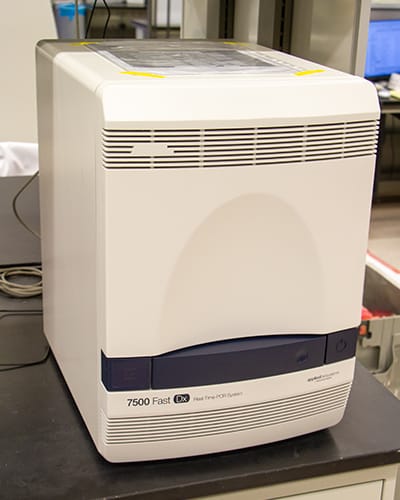
7500 Fast Dx Real-Time PCR Instrument
96-well, five-color platform that uses fluorescence-based PCR reagents along with a specialized optical system for easy calibration to new dyes. Its advanced algorithm minimizes spectral crosstalk for effective multiplexing, and its intuitive software—featuring plate setup wizards and multi-plate data viewing—streamlines data processing and analysis.

MESO QuickPlex SQ 120MM
Rapid read times (as fast as 90 seconds per plate) and the ability to perform multiple, simultaneous tests on a single sample
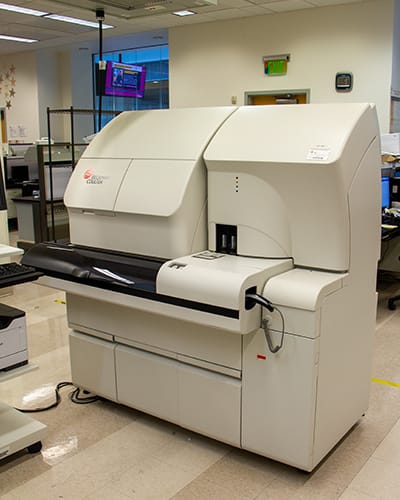
UniCel DxI 800 Access Immunoassay System
Can run up to 400 tests per hour with 120-specimen capacity and each rack is released in less than five minutes.

Automate 2550 Sample Processing system
Automated sample loading and sorting with sorting speeds of 800–1,200 tubes per hour

Biomek i7 automated Liquid Handler
Features large-volume 1 mL multichannel pipetting head and transfer volumes from 0.5 µL – 5,000 µL
Team

Researchers
Administration
Unknown person
Systems Architect and ABCTL HIPAA Security Officer
Arizona State University
Contact
For questions about this facility, please contact:
A dose of facts
Get answers to your COVID-19 questions and see our vaccine infographic.